
What has changed in the last twenty-five years?
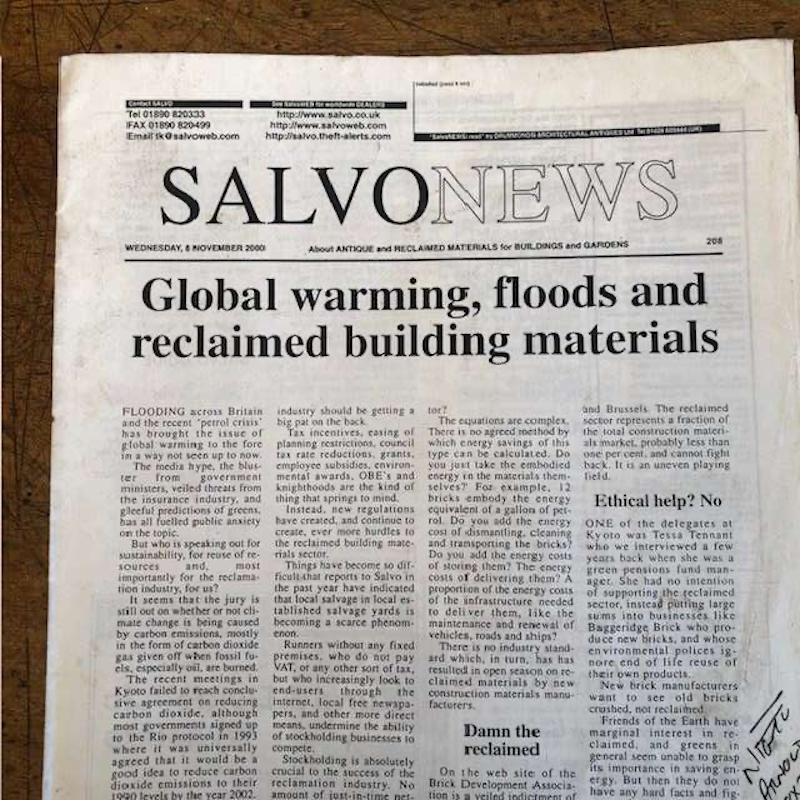
The extract below is from 'Global warming, floods and reclaimed building materials' written by Salvo founder Thornton Kay, a former architecture student, in one of the old printed editions of SalvoNEWS 208, 8th November 2000. Strangely, apart from a few details, such as the international climate change emissions target names (the 1997, Kyoto Protocol has been superseded by the 2015, Paris Agreement), this SalvoNEWS story reads as if it could have been written yesterday. 'Global warming' is now known as 'human-made climate change'. Also, do not panic, there is no current UK 'petrol crisis', but considering world events and our general lack of preparedness from successive governments, that could happen again. Kay also organised the international Comtek '74 (community technology expo) in Bath and went on to start Walcot Reclamation in 1976 with Rick Knapp, the first place dedicated to saving and selling old parts of buildings, named a 'reclamation yard' in honour of the historical name for land behind street frontages dating back hundreds of years.
Extract from SalvoNEWS 208, November 2000:
So where are we now?
'Global warming, floods and reclaimed building materials, 2000, SalvoNEWS printed edition, 8th November 2000, no. 208:
Flooding across Britain and the recent 'petrol crisis' has brought the issue of global warming to the fore in a way not seen up to now.
The media hype, the bluster from government ministers, veiled threats from the insurance industry and the predictions from the 'Greens' have all fuelled public anxiety on the topic.
But who is speaking out for sustainability, for reuse of resources and most importantly, for the reclamation industry, for us?
It seems that the jury is still out on whether to not climate change is being caused by carbon emissions, mostly in the form of carbon dioxide gas given off when fossil fuels, especially oil are burned.
The recent meetings in Kyoto failed to reach a conclusive agreement on reducing carbon dioxide, although most governments signed up to the Rio Protocol in 1993, where it was universally agreed that it would be a good idea to reduce carbon dioxide emissions to their 1990 levels by 2002.
This target will be missed, in some cases by miles. But it is this target which has driven, for example, the EU's directive on domestic waste recycling, which in turn gave rise to the UK landfill tax, which in turn has put very large sums of money into the hands of people who have said thank you but have made absolutely no difference to, for example, the amount of building materials reclaimed from demolition.
It is getting harder:
The encouraging comments from all concerned - the 'we must reuse resources to save energy' lobby - seem to indicate that the salvage industry should be getting a big pat on the back.
Tax incentives, easing of planning restrictions, council tax reductions, grants, employee subsidies, environmental awards, OBEs and knighthoods are the things that spring to mind.
Instead, new regulations have created and continue to create ever more hurdles to the reclaimed building materials sector.
Things have become so difficult that reports to Salvo in the past year have indicated that local salvage in local established salvage yards, especially in city centres, is becoming a scarce phenomenon.
Stockholding is crucial to the success of the reclamation industry … yet more and more stockholding dealers with well-established businesses are looking to either move into the sale of new reproduction materials or use their trading nouse to buy from considerably further distances often overseas.
Energy saving:
How much carbon dioxide is saved by the reclaimed building materials, architectural salvage, and architectural antiques sector?
The equations are complex. There is no agreed method by which energy savings of this type can be calculated. Do you just take the embodied energy of the materials themselves? For example, 12 bricks embody the energy equivalent of a gallon of petrol. Do you add the energy cost of dismantling, cleaning and transporting the bricks? Do you add the energy costs of storing and delivering them? There is no industry standard, resulting in open season on reclaimed materials by new construction materials manufacturers.
Damn the reclaimed:
On the website of the Brick Development Association is a veiled indictment of reclaimed bricks, while ever more reclaimed brick lookalikes are being manufactured and sold into a market created by reclaimed.
Behind the scenes, the manufacturers have lobbyists in London and Brussels working to discourage the reuse of salvaged materials.
Advertising campaigns are being run in building magazines by new building manufacturers damning reclaimed while also importing new foreign building materials.
New brick manufacturers want to see old bricks crushed, not reclaimed.
The reclaimed sector represents a fraction of the total construction materials market, probably less than one per cent, and cannot fight back. It is an uneven playing field.
Ethical help? No:
Delegates at Kyoto had no intention of supporting the reclaimed sector such as Tessa Tenant … instead was supporting new brick businesses like Baggeridge Brick, who ignore end of life reuse of their own products. (Note: Back then, Baggeridge Brick was the UK's fourth largest brick manufacturer and has since become a subsidiary of Wienerburger AG, the world's largest brick manufacturer.)
Friends of the Earth have a marginal interest in reclamation, and 'Greens' in general seem unable to fully grasp its importance in saving energy. But then they do not have any hard facts and figures about the levels of energy saved from the reuse of reclaimed building materials.
Insurance companies:
One would have thought that insurance companies would be in the vanguard of encouraging the reuse of materials to reduce global warming, reduce climate change, and hence reduce flooding and tempest claims.
Far from it. In many instances, it is the insurers who discourage the reuse of reclaimed materials by architects when they refuse to allow them to include reclaimed materials in their 50-year professional indemnity insurance cover for buildings… instead, climate change will lead to increased premiums and maybe more profit?
Money:
So, there is money to be made from climate change.
The rebuilding of storm damage and flood prevention schemes will increase the profits of new materials suppliers. Landfill operators benefit from landfill taxes.
Professionals are being paid to sort it all out. Huge grants are awarded to the consultants offering solutions.
Reclaimed materials threaten their existence, albeit in a tiny way.
Salvo believes that the salvage and reclamation industries' efforts have had a measurable impact since 1990.'
So where are we now, twenty five years later, and has anything changed since the year 2000 when Thornton wrote the above article?
Pushing Reuse research from Thornton and Jonathan Essex, BioRegional was complered in 2009, which put the focus on reuse as the key to 'a low carbon construction industry'. The research had sadly shown that the amount of building material being reclaimed had declined and that reclamation was becoming more difficult in the UK. Ironically the UK government's own policies had even been hindering reuse. Jonathan Essex said, 'Pushing Reuse clearly shows the benefits that reuse brings over recycling. For example, if we reclaimed 50 percent of reusable construction iron and steel the carbon savings would be equivalent to taking 29,000 cars off the road - and that's for just one material. Yes, reclamation is currently more labour intensive than recycling which makes it more expensive, but it creates green jobs and products that often have a higher value than recycled - for instance reclaimed bricks are worth much more than bricks recycled by being crushed to form recycled aggregate'. Thornton agreed calling for the UK Government to produce a new reuse agenda.
Money has since continued to flow with grants and funding for some but the question remains has it been used wisely? In fact, a whole climate change industry has grown since the year 2000, with companies and/or consultants in new roles such as climate change research projects, managing building certification schemes like LEED, BREAAM and WELL, also overseeing and calculating measurements for Energy Performance Certification (EPC), Life Cycle Assessment (LCA), the Circular Economy, material passports for buildings, sustainability goals, plus new ideas and technologies to save carbon emissions from tree planting and nature conservation to renewable energy and carbon capture, together with carbon credits and carbon offsets etc etc.
Simply put where there is money; there are always those ready to 'cash in'. So unfortunately, some of these climate initiatives have proven to achieve very little or been a complete waste of money, just 'kick the can down the road' or are even a complete con. Lobbying from new materials manufacturers with greater power and influence has also taken priority and encouraged recycling rather than reuse. Luckily, there are many still with care for our planet's future, so some grant funding or monetary support has been used wisely and some has achieved valuable results.
One example of a basic but beneficial climate research project, was the Circular Ecology: 'Double or triple glazing? All pane no gain?' This project, from Craig Jones, posed the question of whether, 'replacing windows is the best environmental choice when you compare the carbon footprint and embodied carbon of wooden, uPVC triple, and double-glazed windows'. See more details below, but can we pose the question - did anyone listen?
Circular Ecology: 'Double or triple glazing? All pane no gain?' , 2014:
'Intuition tells us that triple glazing should have a lower carbon footprint. The additional panel of glass in the window provides an extra barrier against the cold air outside. However, this extra layer of glass comes with an additional embodied carbon footprint penalty.'
'Taking an average domestic window (assumed 1770mm x 1200mm) our research showed that wooden frames are, as expected, the lowest embodied carbon option, at 85 kg CO2e per double glazed window, this is followed by uPVC windows at 110kg CO2e per window and finally aluminium at 161 kg CO2e per window.'
'The results showed that for all frame types it takes almost 20 years for triple glazing to pay back the additional embodied carbon' which is 'beyond the lifetime of most uPVC windows and therefore is not quite the obvious choice that you would think.'
Craig's research found that, 'double glazed wooden windows outperform triple glazed uPVC windows over 20 years' and 'if you were to choose uPVC triple glazing over double glazed wooden windows it would take over 50 years.' So, if you consider 'whole lifetime' the research proved the best environmental option is to use wood.
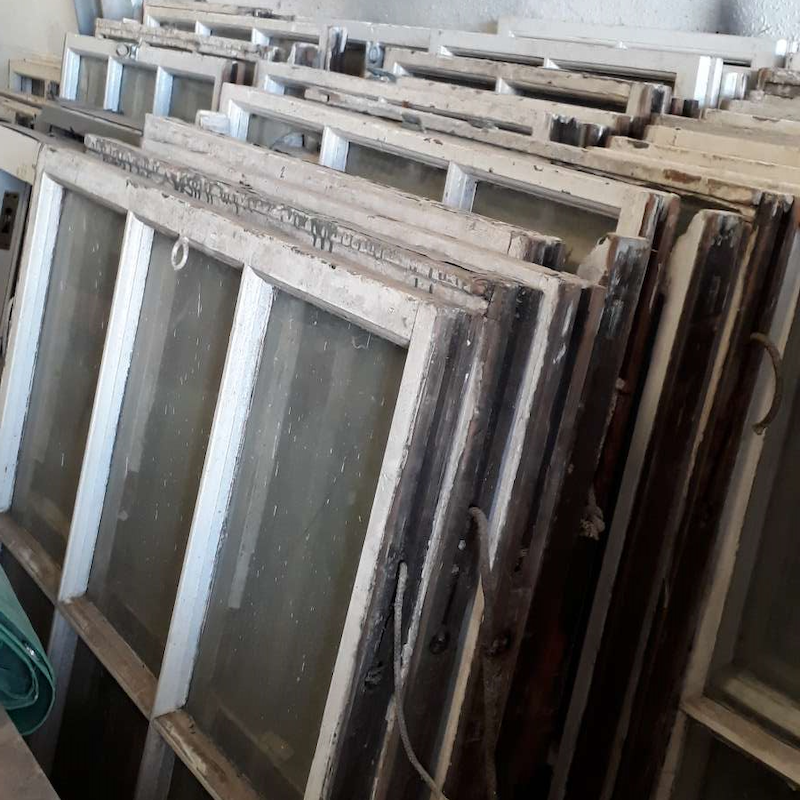
In fact, this would instead point to the benefits of maintaining and repairing old wooden windows. wherever possible, instead of buying new and fitting external and internal reclaimed wooden shutters or extra wooden framed double glazing as the more eco option.
Dr Craig Jones is a well-respected environmental consultant specialising in embodied carbon assessments. You can read the article in full here.
In 2016, The Telegraph reported:
‘that bricks and mortar are the latest casualty of our disposable society, with rich house buyers choosing demolition over renovation. One financial incentive is that a renovation incurs VAT whereas a self build is VAT free.’
Properties chosen for demolition often tend to be less than twenty years old. The newer design and builds that have tended to follow a fashion trend are the ones that have not aged well. Modern architecture has become more difficult to sell than older more timeless designs. The key to standing the test of time being the quality of architecture, materials and craftsmanship. So it is the 1970s-1990s properties that are often discarded in favour of a new build.
The idea that we can dispose of buildings so easily will concern many especially when we consider the carbon footprint. There is a need for much higher standards to be set for building materials to be reclaimed and reused in any new build project. Reuse before recycling is vital. Everyday you can still see skips full of crushed bricks because it takes less time and effort than deconstruction and cleaning bricks to allow reuse. in the UK the waste regulations require reuse as a priority over recycling and energy from waste but little has been done to ensure this happens in practice. Maybe we need to mandate a higher percentage of reuse for all demolition projects.
In 2019, Salvo Ltd itself was honoured to be asked to partner with Rotor, a cooperative design practice based in Brussels, in a recent research project, which also included Bellastock, based in Paris, whose team develops pioneering expertise in France on the reuse of construction materials. In the SalvoNEWS story 'Reuse the pressing issue,' Becky Moles summed up where we were in 2020. Read the article here.
Back in 2020, Team Salvo was asking for reuse professionals to get in touch to support this FCRBE EU project, which aimed to increase all buildings to around five per cent, by value, volume or mass, of reclaimed building materials from the then average of around one to two per cent.
Since then, although many passionate UK construction professionals did support the project, there seems to be more positive action to increase the reuse of reclaimed building materials coming from Europe. In fact, the joint FCRBE research project was initially EU-funded, and Rotor, Brussels has continued with further funded research. Although, Salvo has not, within the UK, we do continue to support the stock holding salvage trade through the Salvo Code membership and Truly Reclaimed label.
So, will the five percent target eventually be achieved in Europe and is there enough support it to be achieved in the UK?
But we await practical global progress in CO2 reduction from the construction industry and signs of any significant growth in the reuse of reclaimed building materials remains painfully slow. Although hope does remain, with a few global governmental support projects.
In 2023, the UN Environment Programme agreed, 'The buildings and construction sector is by far the largest emitter of greenhouse gases, accounting for a staggering 37% of global emissions. The production and use of materials such as cement, steel and aluminium have a significant carbon footprint.' And that, 'solutions to mitigate the buildings "embodied carbon emissions" - originating from the design, production and deployment of materials such as cement, steel and aluminium has lagged.' The UNEP report pinpointed three overarching strategies to decarbonise building materials which could encourage reuse. They included 'avoiding unnecesary extraction and production' and a 'shift to regenerative materials'. Read more here.
In the USA, there was some limited support with the US green deal grants and the Federal Sustainability Plan aiming to achieve a net-zero emissions building goal by 2045, which did include building materials but the focus was mainly on decreasing energy use, reducing water consumption, and cutting waste.
Wildly, the CO2 emissions target, 'net zero', seems to have become a target with little meaning. Net zero is being used more like a buzzword than a method to meet meaningful targets, i.e. a real reduction in global carbon emissions.
Perhaps instead, we should be concentrating our efforts on more practical local solutions combined with globally agreed methods of measurement. For example, in the UK, a strong and well supported stockholding architectural salvage and reclamation trade is vital if large stocks of reclaimed building materials are to be readily available to construction companies. Then, the building industry here could more easily achieve huge carbon savings. A common sense approach remains key to achieving true climate goals; after all, It is not what you say but what you actually do....
Climate jargon is overly complicated too, with industry professionals making it harder for most to grasp little more than the basics. Luckily, a helpful SalvoNEWS article by Thornton Kay, 'The carbon benefit of reusing reclaimed building material', 2016 explained in easy-to-understand terms the carbon benefits of increasing the percentage of reclaimed building materials reused in mainstream construction. You can read the article in full here.
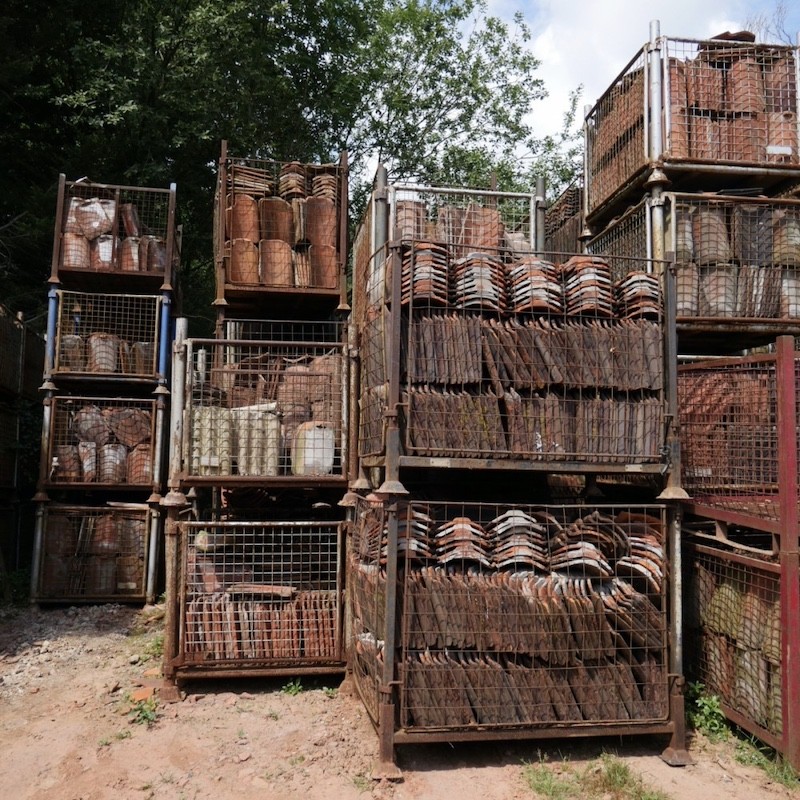
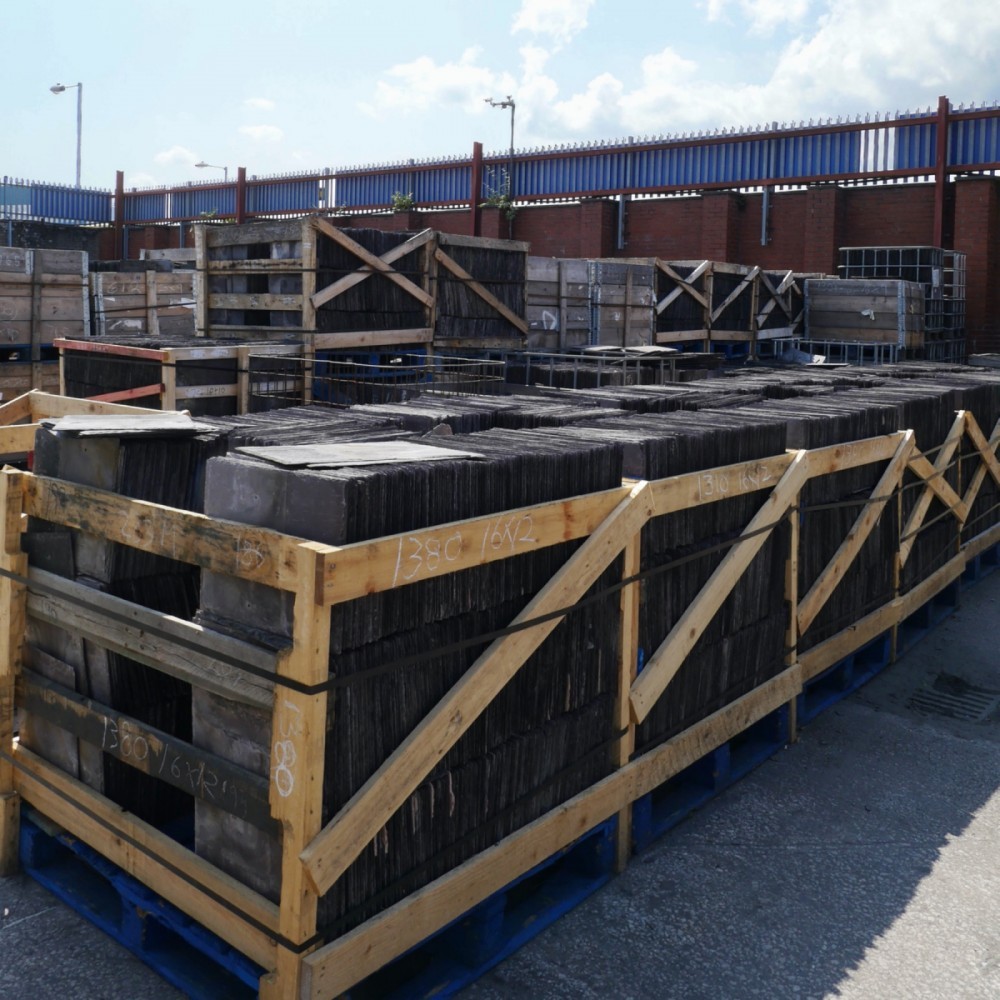
In 2019, Salvo CEO, Sara Morel, also put the carbon saving of the average UK reclamation business into simpler terms in a SalvoNEWS story featuring Roofslates.com. This salvage business in Ashton-under-Lyne was being reviewed by Salvo for the FCRBE, EU-funded research project. Team Salvo discovered that this reclamation company had 'saved around 650 tonnes of carbon dioxide (CO2e) annually, the equivalent energy needed to build 80 new houses made with reclaimed building materials for the walls, floors, and roof. Alternatively, it would be enough to run two indoor civic swimming pools, build 8 new houses using new materials, manufacture 2 large wind turbines, or make 50 new electric cars'. Read the full story here.
Given facts in simpler form, most people would understand why the salvage and reclamation trade should play a vital part in any governement's climate action policy. So why has there been little, if any, practical government support for the stock holding trade?
Meanwhile, when we look at the actual results of global climate policies, it makes you wonder if the people with the power and influence are listening or if the majority of 'climate action' so far has proven to be just 'hot air'. Global CO2 levels have continued to rise just as steadily as before. See below the latest global CO2 monitoring figures from Mauna Loa, Hawaii, where they have been measuring CO2 since the pre-industrial era.
So where are we now heading, and is there hope for more positive change in the next twenty-five years?
'Reuse for the world you want' is Salvo's motto, but is anyone listening?
We appreciate your feedback, so please get in touch views and comments are very welcome.
-----------------
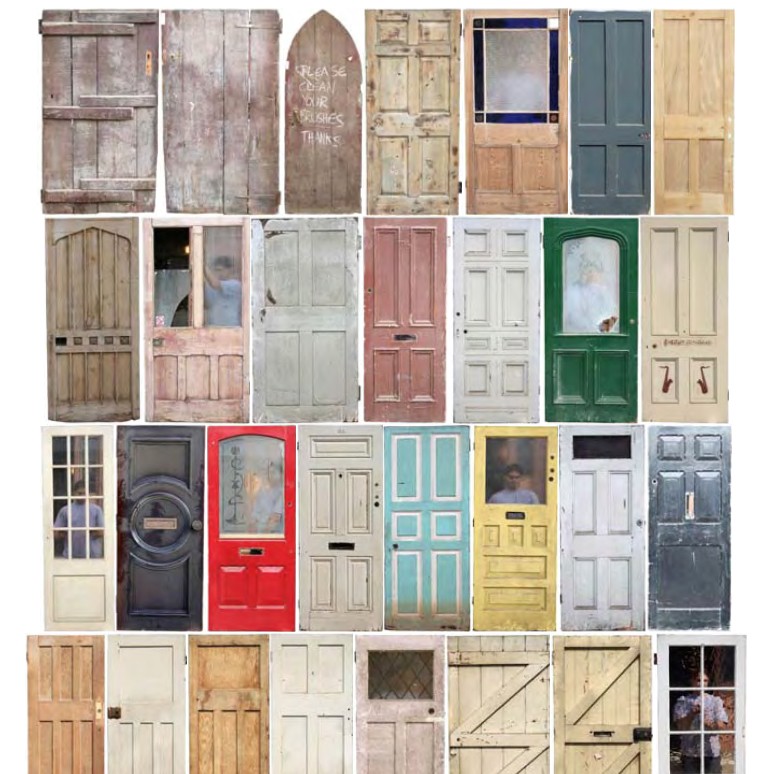
Main image: The reclaimed door poster was created by Salvo in 2005. Lily Kay photographed the doors from a stock of 2,000 at Cox's Yard, Gloucestershire, a long-established Salvo Code member architectural salvage business run by the late Peter Watson, which has since closed its doors. It states: 'These antique and salvaged doors are from a typical architectural salvage yard. Around 100,000 old doors are rescued by the UK architectural salvage trade each year, but 2,000,000 more are simply thrown away. Reclaim and reuse yes please, destroy and recycle no thanks.'
Story Type: Reference