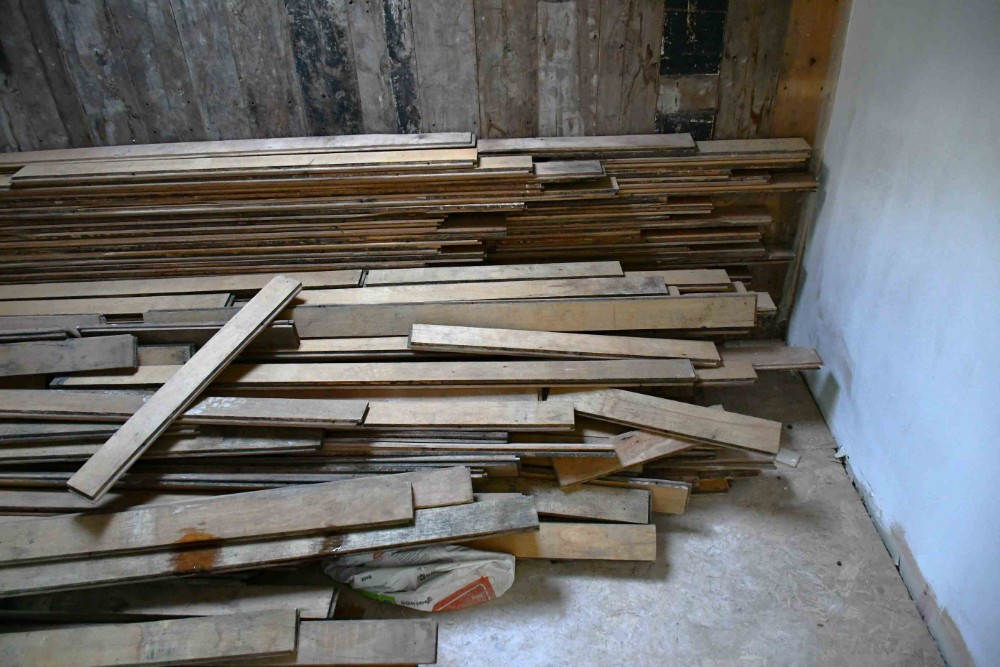
The new reclaimed building project progressed quite slowly last autumn. We sold the house and shop in August and moved the business online, which took up much of everybody’s time and effort. We have had to move into our holiday cottage, temporarily, until the new house is finished, but now, with the coming of a new year, we are all back onto the build with enthusiasm and at pace. In the interim, a large amount of the work that has not been reclaimed has been completed. With most of the windows in place, we have a watertight environment. Now, with the majority of the walls that are not clad, plastered and with the underfloor heating, first fix plumbing and electrics completed, we are progressing with the interiors.
Reclaimed Wood Flooring
There is a reclaimed market for all types of flooring that can be purchased new, so our choice is not so much availability but what suits the house. Although we have a large floor area to cover, quantity is a consideration as we want a relatively uniform look to the interiors.
Our original showroom had a perfectly polished concrete floor, and I was very keen to preserve as much of this as we could. This has been kept for our new kitchen floor.
Throughout the rest of the property we are having wooden floors except in a couple of the bathrooms and the utility room, which is being tiled. I’m not really a carpet sort of person, preferring timber floors and vintage or antique rugs. The choice of wooden flooring is immense, from Victorian Douglas fir floorboards to modern engineered eastern European oak. All are pretty durable with the right treatment and finish; all should be relatively stable if dry and well-seasoned, and all will look lovely.
Our choice was governed by what was in my timber shed in abundance, and, like, I suspect, many yards up and down the country, we have piles of parquet. Why? Well, builders and DIYers are wary of parquet because of the labour involved in getting it laid. It is usually a cheap product to buy from a site, and so it should be, as, if originally laid on bitumen, it is easy to lift with a shovel. The expense and labour come in preparing it, cleaning the blocks, and making a smooth, flat sub-floor to glue them to.
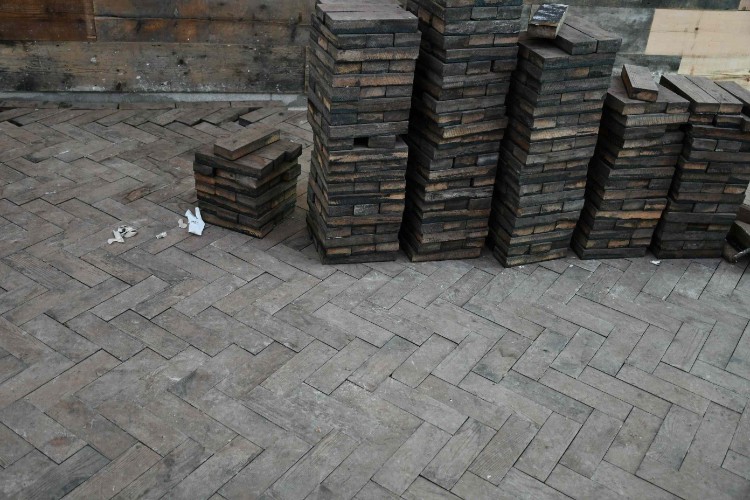
We are using 100 sq m of a pitch pine block from St Clements church in Ipswich. I purchased this a few years back for £6 per sq m plus transportation. Each block is 42mm thick, and the original intention was to split the blocks, but finding a wood yard with time to do it proved difficult, so we just cleaned them instead.
How to clean a reclaimed woodblock:
It’s easy. Choose a cold day. Get a hammer and a scraper. Hit the bitumen hard on the bottom of the block, and it will shatter enough that you can scrape all the lumps off with your scraper. Clean the sides and go onto the next block. After a couple of weeks of this, you will be as fed-up as my staff were, but it will be job done and you will be ready to lay a beautiful floor.
Our floors are laid in a herringbone pattern with a border around the edge. Start in the centre and move to the sides so the floor is symmetrical. Lightly sand to remove any high edges and wax or oil.
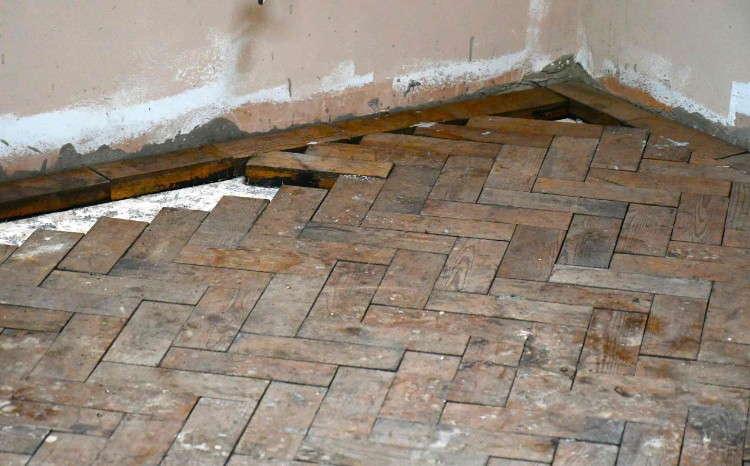
In the upstairs bedroom we are using a beech strip floor. Beech and Maple, being very hardwearing and easy to maintain, were commonly used in gyms and squash courts. We had a large quantity of this flooring from a gym that does not have an enormous market in rural Norfolk. Most of our customers are looking for antique pine or oak for renovations and extension to period property, but this style of hardwood floor, being warm and light, will be ideal for our building.
Reclaimed Tiles
There is a great danger that reclaimed building materials will run out, not for lack of availability but because so many cannot be removed without damage. An important message to anyone using reclaimed materials is to use a reversible method of fixing. Floor tiles are available in abundance, but anything laid in the last 50 years will probably break rather than lift due to the cement content of the mortar that they were set on.
Antique floor tiles and stone coverings vary an enormous amount depending on the part of the country that you live in. In Norfolk we have beautiful pamment tiles, which will be described in depth later in this blog, but we are not using them in the house as they do not really suit the style of the interiors. With the invention of machine-made clay tiles, the Victorians created a more uniform and harder tile, which we have incorporated into this build.
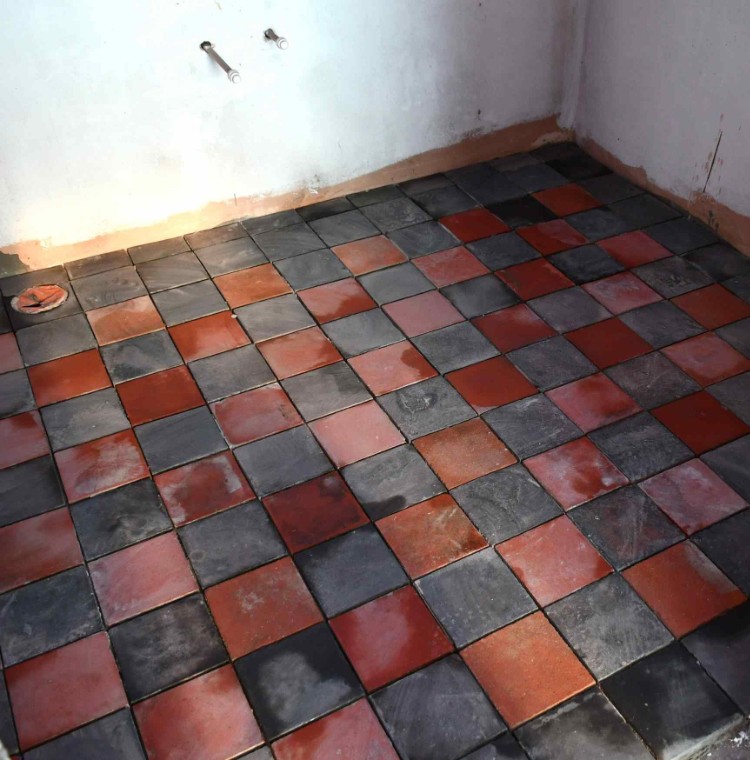
These six-inch square quarry tiles, which our builders lifted from a restoration in a Norwich church, are perfect for two small bathrooms. The black tiles are Staffordshire blue clay, reputedly the hardest clay known in the British Isles, and widely used for exterior paths and hallways, where something hardwearing and frost resistance was needed until the raw material ran out in the 1920s.
Story Type: Columnist