Warwickshire, UK
Tests to indicate the likelihood that a building stone will fail in some way have been sought and tried throughout history. Porosity is one of many characteristics used, and density another. The ancient Roman building technologist Vitruvius (75 - 15BC) wrote about stone types and quarries in his Ten Books of Architecture, and Christopher Wren (1632 - 1723) famously scoured Britain's stone types before plumping for Portland stone for the rebuilding of St Paul's Cathedral. Robert Adam (1728-92) chose Craigleith for his finest Edinburgh works. The Victorians - people like the great engineer John Rennie (1794 - 1874) - tried to emulate the effects of freezing by saturating stone with salt solutions and then seeing whether the recrystallisation caused it to delaminate.
The BRE took on the mantle of British stone testing and standards in the twentieth century eventually resulting in the BS5390 standard which has now been superseded by the EU technical committee CEN/TC 246. Dr. Tim Yates at BRE is the UK's representative on this committee, and coincidentally.
He is also Salvo's contact for representation of the UK salvage trade on issues connected with EU Construction Products Regulations and CE marking where the European new construction materials sector is permanently lobbying to prevent materials being used which it has not sanctioned, including reclaimed building materials, such as reclaimed walling and flagstones. Over the years Salvo seems to have been the only organisation that has stood up to these efforts.
Eric Bignell, editor of Natural Stone Specialists wrote an article about a recent meeting held by Men of the Stones in Stamford to which Maurice Rogers, a materials engineer, was invited. Mr Bignell wrote:
Maurice's work has brought him into conflict with the way stone is tested and how the results are presented. In particular he thinks tests such as freeze-thaw cycling and compressive strength are overly complicated, unnecessary and carried out too infrequently to be of value. He particularly takes issue with the testing regimes required by CE marking, especially when they produce what he sees as pointless results such as 'lowest expected values' (LEVs), which he says accept and predict a failure rate of 1:50 (2%), which is anathema to him after so many years spent in quality control.
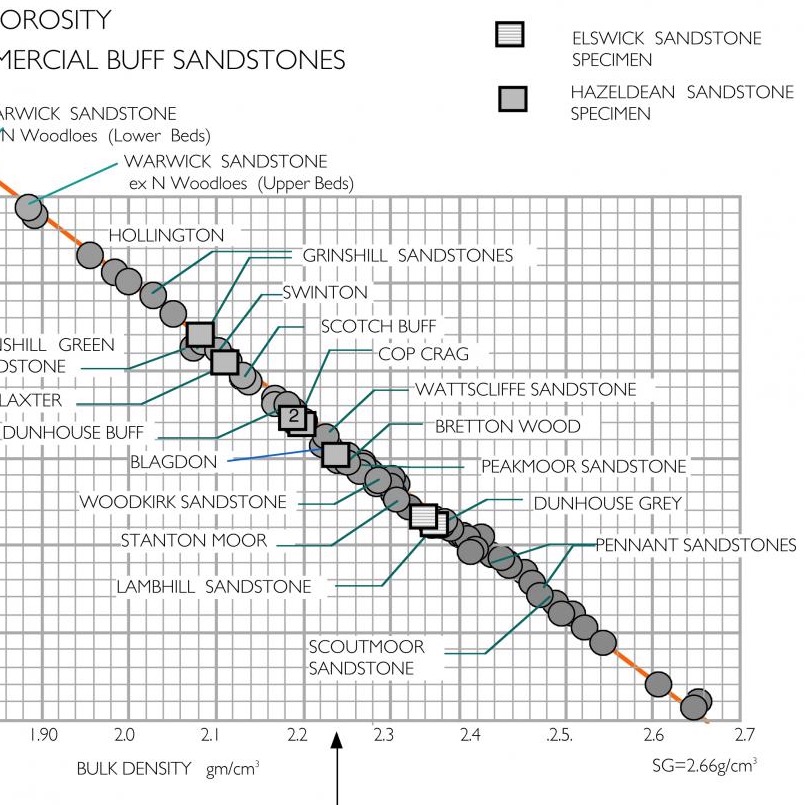
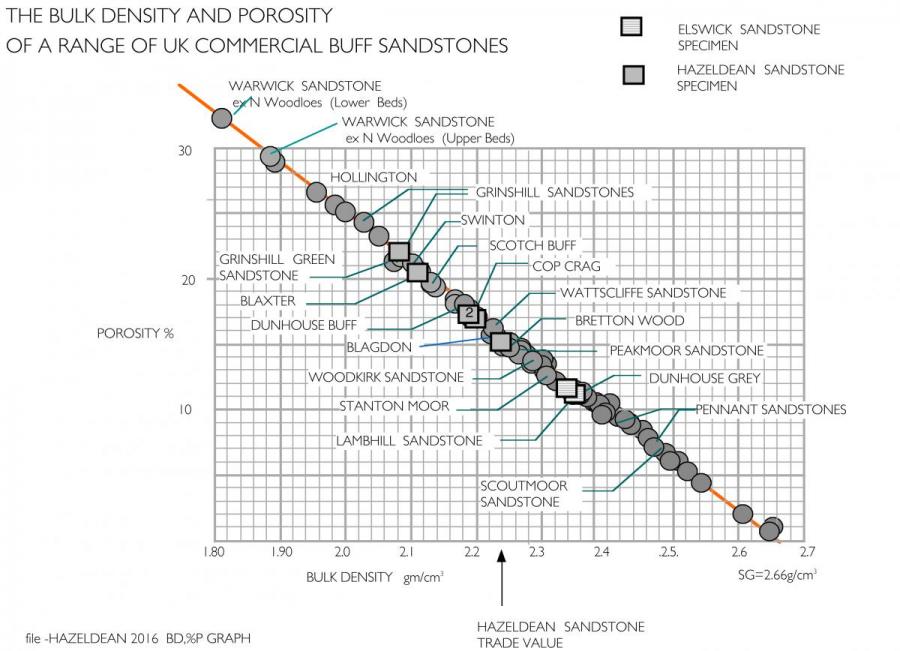
Maurice has devised a set of simple, repeatable and predictive tests of his own. By plotting the results on graphs he produces clear correlations between cause and effect - such as the one on the left showing a relationship between density and porosity. The tests can be carried out easily without using expensive equipment (by stone producers themselves, if they want to do them themselves) in minutes, rather than the weeks taken by testing laboratories. And because he plots the results on a graph, any discrepancies indicating a change in the stone being extracted are immediately obvious.
Because Maurice is working in heritage building conservation, CE marking does not apply to the stones he uses in any case, so he could just get on and do his own testing in the way he sees fit without contravening any laws - and CE marking of stone products is, of course, currently a legal requirement for uses such as cladding and paving. Nevertheless, Maurice is so incensed by what he sees as bad science in the CE mark tests that he continues to campaign against it.
When CE marking became incorporated into construction law for some stone (and other) building products in July 2013, many companies were concerned about it. Now those who need to have come to terms with it. But Maurice niggles away at companies such as BRE and Sandbergs that are carrying out the tests and the stone producers he comes into contact with in the course of his business, especially when the test results they present him with do not tally with his own test results.
During his presentation to the Men of the Stones he demonstrated the capillary test he conducts. It simply involves standing samples of stone in water and measuring how high up the stone the water migrates in set periods (measured after one minute, four, nine, 16, 25 and 36 minutes). This is Fick's Law, which Maurice described as "one of the most crucial tests I do". He said: "It is an incredibly precise law."
He believes this, in conjunction with other simple tests (such as bulk density determined by accurate measuring and weighing, and hardness determined by cutting the figure '2' into a stone surface), provide you with all the information you need to determine the strength and durability of a stone. All the tests produce repeatable, accurate, transparent results, which Maurice does not believe can be said of all the tests required for CE marking.
He explained that, when choosing stone for conservation work, he would always want to use a material that was compatible with the surrounding stone in terms of weathering, otherwise replacement stonework could accelerate the decay of the existing fabric of the building. The tests he carries out determine that compatibility. He gave some examples of projects on which he had worked. One was a railway station in Birmingham where the proposal was to use Grinshill sandstone. Maurice tested 13 different sandstones against the original material and determined Grinshill would not have been the most compatible choice.
He spoke about various other projects where he had determined which stones should be used. On more than one occasion he had discovered that stones being sawn as a single bed from a quarry in fact consisted of two or more beds with different properties. In the case of Clashach in Scotland there were three different beds all with different densities.
Afterwards, Maurice told Natural Stone Specialist magazine: "I am not opposed to CE marking if it means that we have a meaningful and trustworthy scheme for assessing stone supplied to architects and their clients. But architects need to be assured that the data they receive will not be subject to the doubt that the data are in any way suspect."
He said his main concerns about the CE mark scheme as it stands are:
The Scheme suggests that testing need be carried out at no more than two-year intervals
The Scheme suggests that it is appropriate to base the way the stone varies merely on six samples
The Scheme suggests that the size of specimen representing many tens if not hundreds of thousands of cubic metres of stone shall be a mere 50mm cube
The Scheme adopts a term that places the MD of a supply company in an ethical dilemma of having to admit that the stone he has supplied will, if inspected, be found to have some stone below a lower threshold, which could lead to worries in the event of a failure leading to injury and death.
He continued: "When I met Dr Yates at the BRE in 2013 and went over this with him he did not demure but said (I quote): 'It is the Law'.
"I remain polite and respectful but advise all my clients that the CE certificates supplied to them and which are based on the errors above are to be considered as untrustworthy and therefore of no value."
One of the worst aspects of British Standards, EU CENs, CE marking and the like, is the singular lack of representation by stakeholders such as the salvage trade, and perhaps far worse, just plain ordinary normal consumers. Of course, having ordinary people on committees whose objectives appear to be to consolidate and maintain commercial control, rather than to improve the world we live in, would be seen as a retrograde step by construction professionals.
It is refreshing to learn that Maurice Rogers, a construction professional, is making a stand against the combined might of the construction materials industry.
NSS Eric Bignell: Maurice Rogers talks about stone testing to Men of the Stones
BGS: Building stones of Edinburgh: tests and properties
Story Type: News