London West, UK
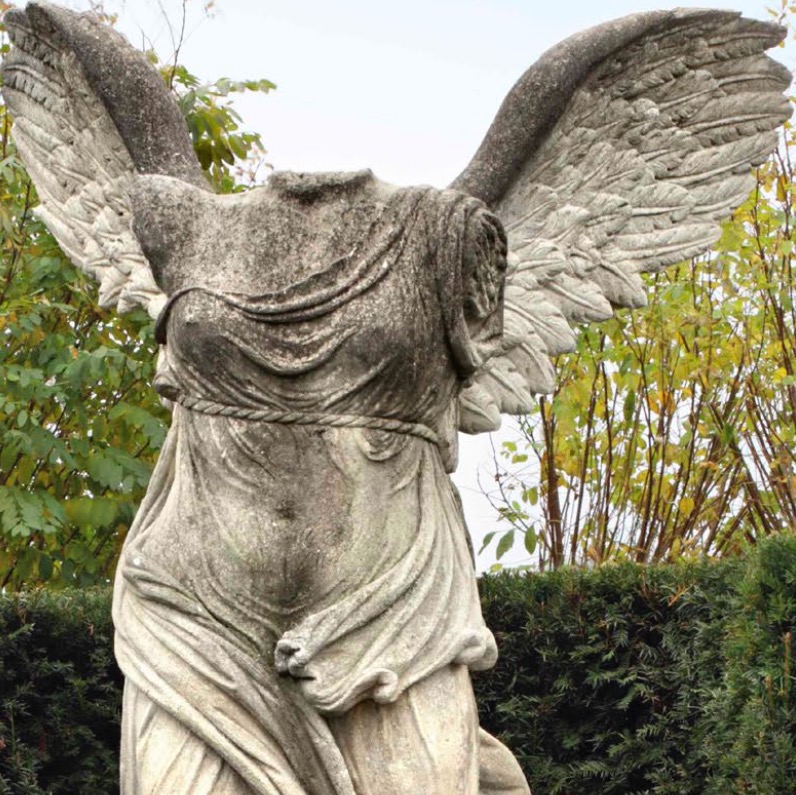
A twentieth century marble copy of the ancient Greek sculpture known as the Winged Victory of Samothrace sold for a quadruple low estimate £44,640 at a sale of garden ornament and fireplaces from the Piet Jonker collection held by Dreweatts on 27 May.
The original, now in the Louvre, was discovered in 1863, and is thought to have been created around 200-190 BC. The work is 2.44 metres (8 feet) in height and was commissioned to commemorate victory in a sea battle as well as in honour of the goddess Nike. It is famed for the way in which it conveys a sense of action and triumph as well as portraying artful flowing drapery, the goddess being portrayed as descending to alight upon the prow of a warship
Rendered in grey and white Thasian and Parian marble, the figure originally formed part of the Samothrace temple complex dedicated to the Great gods, Megaloi Theoi. It stood on a rostral pedestal of grey marble from Lartos representing the prow of a ship (most likely a trihemiolia), and represents the goddess as she descends from the skies to the triumphant fleet
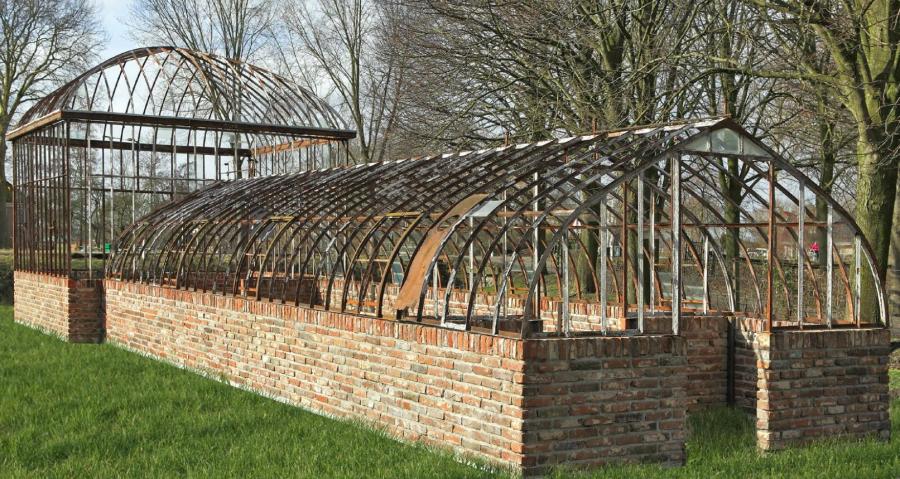
At a low-estimate £43,400, the second highest lot was a French glasshouse, with a 4.9m high domed orangery, and a 14.5m long greenhouse, of wrought iron on brick plinth walls, very unusually, sold with a detailed condition report containing estimates for the cost of repairs and rebuild. We do not known whether this report was instrumental in securing the sale. Here it is:
Piet Jonker has stated that parties interested in this lot are welcome to discuss its full renovation with him.
There are very few glass panes present with the lot and the structure will need to be entirely re-glazed.
The iron framework is oxidised overall, but there is no loss of structural integrity on the whole. However some of the metal work will need to be replaced, especially the horizontal beams that run along the top of the brickwork, and the horizontals beneath the pyramid roof of the orangery section. Much of the metal work contains old putty which has solidified, and will need to be removed.
The bricks are period, antique bricks and are sold with the lot. During disassembly these will need to be cleaned of the current cement prior to re-use.
The concrete base layer is modern and is sold with the lot. It disassembles into sections
The attention of prospective buyers of this lot is drawn to the following:
Piet Jonker has had a specialist metalworker look over the orangery and greenhouse, and the following conclusions were reached:
1. Prior to any re-assembly in a new location, the iron framework will need to be professionally cleaned of the hardened putty which used to hold the glass panes in. The cost of this work is estimated at €1500.
2. Following the removal of the old putty, the iron framework will need to be shotblasted so that the rust is removed. This would be followed by the application of suitable treatment / sealant to prevent future rusting in the immediate future. These treatments would cost an estimated further €1500.
3. As the condition report above specifies, some elements of the ironwork will need complete replacement, mainly horizontal sections where water has sat over the years. Also the corner uprights. The handles and hinges of the doors and windows would also need to be completely renewed. (See extra images for details of the rusted parts and the doors, windows and extra parts). This work is estimated to be in the region of €9000
4. Following the removal of the old putty, the shot blasting and the replacement elements, the metal structure would need a final shotblasting before being coated in rust retardant undercoat, and this would cost a further €1000
5. It is estimated that the transport of the disassembled and restored orangery/greenhouse would be in the region of €2000.
6. It is estimated that the cost for a glazier to replace all the glass once the structure has been rebuilt, would be circa €10,000.
7. Piet Jonker will disassemble the whole structure, including the bricks and concrete base layer for the buyer. The bricks will be cleaned of the current cement and the whole structure would be prepared for shipping. This would not incur an extra charge.
8. It is estimted that a complete rebuild of the structure, after the restoration work, (and before the new glazing) would cost €10,000. It would take four men, two weeks to complete (without the glazing). The bricklaying alone is known to take three workmen three days, but time must be allowed for cement to set. There would need to be a suitable preparation of the ground, as well as the insertion of the foundation piles prior to the laying of the concrete base beams, and then the bricks and metal above that.
This cost is based on a local rebuild.
9. It has been suggested by Mr Jonker that whilst the restoration of the metalwork is a necessity prior to any rebuild, any prospective buyer might be advised to utilise a building company in their own locality, to avoid the extra costs of hotels for Mr Jonker's men.
10. The consultant metalworker is a specialist in iron, and has said that the guttering is of zinc. This has corroded and deteriorated and a quotation from a specialist in zinc will need to be got, for restoring the guttering.
While the auction took place at Mallett of Dover Street, London, most of the lots in this sale were located at Piet Jonker's premises in Holland. These occasional sales have in the past taken place at Billingshurst, formerly Sotheby's and now Summers Place Auctions, as well as Christie's in Amsterdam.
The sold percentage was around 45% by lot.
Piet Jonker
Salvo Directory 18 Oct 2005
Dreweatts & Bloomsbury Auctions
Story Type: Auction Report