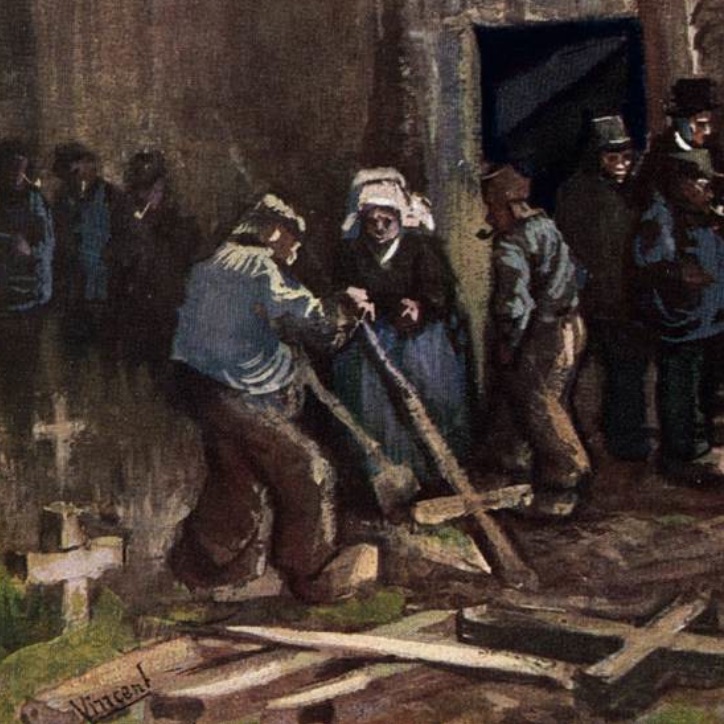
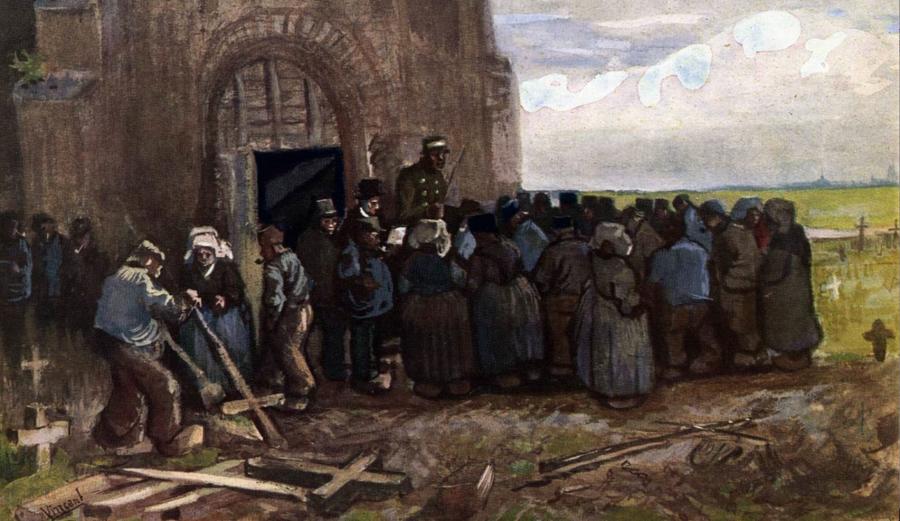
At Reclaim+Remake in Washington D.C. last week Jan Jongert of the Dutch innovative reuse designers, Superuse, opened with Van Gogh's
Sale of Crosses at Nuenen Cemetery, and proceeded to run the gamut of their modern salvage architecture projects which included reusing the internal skin of aircraft to house avant-garde recreation, and a thousand dismantled cable drums dismantled and reassembled as external cladding for a private house. Nuenen is not far from the Superuse studio in Rotterdam.
Van Gogh (1853-90) took up full time painting in 1880 but before that had been apprenticed as an art dealer, turned to religion studying theology at Dordrecht and then became a preacher (like his father and grandfather) which he gave up in 1879.
In December 1883 he moved back to the family home, a fine vicarage, in Nuenen, Brabant where his father was a Calvinist pastor of the Dutch Reformed Church. His studio was in a converted laundry room at the back where he painted using heavy earth colours in a dark realist style mainly landscapes, peasants and weavers.
His father died in March 1885 and by June he moved south to Paris and then again to southern France where he painted frenetically before being confined to an asylum after his tempestuous relationship with his friend Paul Gauguin resulted in cutting off his own ear in 1888 and dying in 1890.
The demolition of Nuenen church took place in May and June 1885 although it had been ruinous for a while. The 'sale of building scrap' which seems to have been the working title for the painting and is mentioned dispassionately by Van Gogh in letters in 1885 included wooden cross grave markers as well as the spire, stone, timber, roof slates and the spire's iron cross. Van Gogh wrote to his art dealing brother Theo:
My dear Theo,
Many thanks for your letter and for the 50 francs enclosed, which was very welcome to me this month in particular, what with the move. I think that I'll save a very great deal of time in the long run by living in the studio, since I'll be able to get started first thing in the morning, for instance, whereas the way it was at home I couldn't do anything.
I've been slogging away at drawings these last few days. The old tower in the fields is being demolished. There was a sale of woodwork and slates and old iron, including the cross.
I've finished a watercolour of it in the manner of that timber sale, but better, I think. I also had a second large watercolour of the churchyard, which has so far been a failure.
[Neunen Fri 22 May 1885]
During this period Van Gogh painted a series of paintings of the 12th century church tower mostly with the spire intact as a tribute to the simple, humble lives of the peasants who 'for centuries have been laid to rest, among the fields in which they rooted when alive'. The ruined tower he apparently saw as a symbol of the declining role of Christianity in people's lives - arguably Van Gogh's own life.
Of the church tower paintings Vincent wrote, 'I wanted to express how perfectly simple death and burial is, as simple as the falling of autumn leaves - just some earth dug up - a little wooden cross. The fields around - they make a final line against the horizon, where the grass of the churchyard ends - like a horizon of sea. And now this ruin tells me how a creed and religion have moldered away, even though they were so well established - how, nevertheless, the life and death of the peasants is and remains the same: always sprouting and withering like the grass and the flowers that are growing in this graveyard' [letter to Theo].
Around the tower was a cemetery which Van Gogh called 'The Peasants Churchyard'. His interest in churchyards and cemeteries came as a result of frequent visits when he was a child to the grave of his older brother, also Vincent, who was stillborn.
His time at Neunen culminated in his best known painting at that time - 'The Potato Eaters' - symbolising the poverty of the local peasants and their food rooted in the land in which they were born and died.
There is no record of why Van Gogh painted the sale of church salvage, but his wealthy background, his earthy realism and his contact with his art dealing brother imply passive acceptance of the status quo, of an unremarkable event, rather than some kind of pointed message. It is quite likely that the 'sale of building scrap', or 'sale of crosses of Nuenen cemetery' as it became known, was embellished or even a fictionalised account of the demise of the tower, as were some of his paintings where people were added into landscapes afterwards.
The painting is in the Rijksmuseum, Amsterdam.