London East, UK
Patrick Williams, a London interior designer, featured in November's House & Garden magazine, sent us answers to questions outlining his background and the way he works. If you are then inspired to find out more discover Berdoulat.
How and why did you become an interior designer?
On Graduating, I got a job as a graphic & website designer. It was a 9-5 office job and I hated every second of it. It did however allow me enough of an income to get a mortgage and buy my first project, which was a dilapidated garden flat in Brixton. I would work away on the flat in the evenings and at weekends (much to the chagrin of my ever patient neighbours). There was nothing I enjoyed more than coming home after a boring day in the office, and ripping out a false ceiling to discover original mouldings, or wielding a sledge hammer and knocking out a covered up fireplace. I got the bug. In fact, it was a bug that I had got in early childhood witnessing my parents doing the same thing at our family home Berdoulat, an 18th century farmhouse in South West France. I realised I needed to try and turn this hobby in to a profession, so handed in my notice and subsequently established Berdoulat Ltd. (named after my family home).
Where did you study/train?
I did a brief internship at an architecture practice, and quickly realised that the conventional approach with 7 years' training, followed by decades of not really being responsible for creating much, with no real hands on engagement in the process of building, would not suit me. I sub-consciously circumnavigated a degree in Architecture, and embarked on a different training which would satisfy me creatively, and allow me to work in a more direct way on period buildings, where my passion lies. This training began with my reading Fine Art at Oxford University. It was a fairly academic course compared to other Art Schools with an emphasis on Life Drawing, which I enjoyed hugely. We even did Human Anatomy alongside the medics, with our own cadaver to dissect and draw sections of. The course nurtured a deep fascination with colour, form, space and light - the key ingredients of Interior Design. When I began working on period buildings following university, I realised that as an artist, buildings are my medium. I have learned a great deal from restoring buildings over the years, and working alongside skilled craftspeople in all fields. I owe a great deal to my friend Marcus, a very talented cabinet-maker who I am an ongoing apprentice to. He has taught me a lot about wood and joinery techniques. I believe it is essential to understand the building & making processes in order to successfully design, and project manage others executing a design.
What or who are your main influences?
Kettle's Yard, Cambridge. If you have not been to visit this place then you must. It is my Mecca, and I have to go at least once a year. It was conceived by Jim Ede, a curator at the Tate in the 20s and 30s who bought 4 cottages in Cambridge in the 50s, and knocked them together to create one house which was then extended in the 70s. He built up relationships with many of my favourite Cornish artists whose work is displayed in the house. He would hold an "open house" where anyone could come and look at his art collection. Not only has he curated art so beautifully in a domestic setting, but the way in which works are displayed alongside furniture and decorative objects has the effect of blurring the lines between Fine Art, Interior Design and Architecture, and thus the whole house is one artwork.
William Morris and his entourage are very influential too - not just for their aesthetic qualities, but their approach to Design and Making.
My parents are probably my main influences. They create wonderful spaces - always keen to use traditional local building techniques. My father has a "recipe book" that details which sand from which local quarry should be used in what measure to ensure a given render has the right colour! They also enjoy working closely with local craftspeople. One such local is Didier, who has become a life-long friend. He runs a Brocante in a village near Berdoulat and is extremely knowledgeable and gifted when it comes to antique furniture. He supplied us with most of the materials we needed to restore the house, from 18th century floor tiles, to handmade nails and hinges. Indeed, once we got a call from him saying that a nearby house was due to be bulldozed the following day, and that it had its original floor tiles still in tact. We jumped in the car armed with crowbars and lifted the entire floor in the dead of night, before crawling home, fearful that the suspension would snap under the weight! Following days of scrubbing, with the whole family mucking in, we then laid the tiles in our own house and they looked like they had been there for 200 years. I earned my first ever pocket money (10 Francs) moving those tiles from car, to scrubbing table, to the room they were destined for in a wheelbarrow!
How would you describe your style?
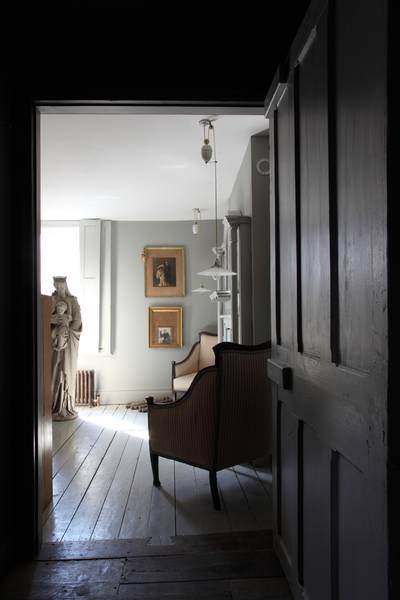
If you're working on a half decent period building, I think that often the best thing you can do is let what is there already dictate an approach. Strip back and discover what remains of the original fabric of the building, and add in a sympathetic manner. I love working with materials which are inherently beautiful, and using their natural textures and/or colours. MDF is a swear word at Berdoulat.
What are you working on at the moment, and what is next?
I am currently installing a fireplace, panelling and library bookcases which I designed for a house on the Gorhambury Estate, Hertfordshire. Following that we will start work on restoring a house in Flood Street, London.
What are the best and worst parts of your job?
Best part: when you remove laminate flooring from a building, you can if you listen hard enough, hear the building whispering "thank you!". I love putting back what's been removed and discovering what remains in old buildings. We have such a rich and varied architectural heritage in Great Britain and it's vital that we preserve our buildings for future generations to enjoy. If I feel I have successfully achieved this whilst creating a beautiful home or environment for the client, then I am extremely satisfied. Worst part: it's great being your own boss most of the time, but I have found it hard to stop, and take quality time off. The practice is my baby, and I find it hard to delegate enough for me to escape sometimes.
What do you like to do in your spare time?
Recently I have enjoyed exploring parts of the UK that I have never been to. As a child I was always whisked off to France each and every holiday and I really don't know my own country very well as a result. Bath is a place that seems to have a magnetism for me… I wonder why?
Update:
Berdoulat, interior design is now based in Bath:
'As a practice, we specialise in period buildings and restoration. “The customer is always right” as the saying goes. However, we also like to consider the building as our client too, and respond to its character, its mood, style, and spirit.
We undertake work on all levels, in the commercial and domestic sector, from the design of whole buildings, through to sourcing an overmantel.'
Berdoulat
Story Type: Feature