New York, USA
In November 2001, antique garden statuary specialist Hilary Chelminski held a selling exhibition in Chelsea which included a Coadestone version of a Roman marble sarcophagus for sale at £32,000, of which the Roman marble original once owned by George, Duke of Buckingham, was known as the Stow sarcophagus.
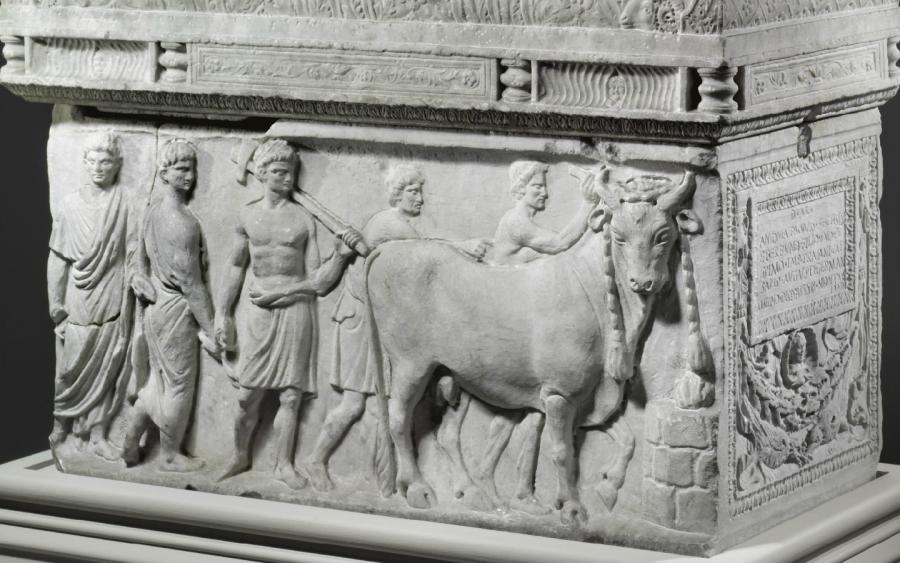
On 8th June 2011 a marble Stow sarcophagus was sold at Sotheby's New York for $98,500 (est $15,000-$25,000), not as a Roman original, but as an eighteenth century Italian copy, possibly by the workshop of G B Piranesi. Sotheby's catalogued the lot as c1770-80 and stated:
'The present urn was long considered to be one of the most important antiquities in the collections of the Dukes of Buckingham before their dispersal in 1847. In fact, the 'Stowe Sarcophagus' is one of the most ambitious pseudoantiques ever produced by late 18th-century Roman workshops for their English clientele. The engraving of 1847 and
the coadestone cast show that the urn originally rested on a highly ornate marble base typical of Piranesi's production.The 1798 description of Stowe by J. Seeley specifies that "the covering to it is a mattress, upon which lies a snake, and a human figure of very capital workmanship is reclining in the folds of it."
Eleanor Coade said there was a naked figure lying on a serpent on the lid and an inscription saying it was made in the time of Trajan. Further she said, "It is impossible to give an adequate description of the exquisite workmanship of this piece of ancient sculpture." She had moulds made from which the Coadestone versions were cast.
The story goes that the Duke of Buckingham's Roman marble sarcophagus was found near the Villa d'Este at Tivoli, about twenty miles from Rome, beside the ruins of Hadrian's villa, where a treasure trove of marble and bronze was discovered including Antinous, the Furietti centaurs and the Warwick Vase. The villa had been known since the early fifteenth century, but it was not until 1550 that Cardinal Ippolito II d'Este, governor of Tivoli, started excavations in earnest to provide materials for decorating his new villa. Cardinal Albani continued the pillage, along with Cardinal Furietti, and Gavin Hamilton who in 1771 discovered what became the Warwick Vase. The marble sarcophagus was sold by Buckingham to a Mr. Norton in 1848 and had not been heard of until 2011.
The relief scene: The Coade sarcophagus was 28ins long, with a relief of a Roman sacrifice of a cow or heifer (interestingly, definitely a bull on the Sotheby's Stow sarcophagus) decorated with woollen tresses being led by toga-clad men, one of whom is carrying a sacrificial pole-axe. The cow or heifer would have been washed and adorned with ribbons and strips of white or scarlet wool, the horns gilded. Roman sacrifices required a female animal for a female deity, apart from Jupiter to whom both male and female sacrifices could be made. The animal should show no sign of panic, which would have been a bad omen that polluted the sacrifice. The poleaxe would have stunned the animal rendering it instantly unconscious, it would then have been cut open and bled to death, the entrails would have been inspected by a priest and provided they were satisfactory the sacrifice was deemed complete, the animal would then be roasted and eaten at the subsequent feast. Cow or heifer sacrifices were made to Jupiter, Juno, Salus, Victoria, Penates, Lar or Genius Loci and Tellus. Roman sarcophagi and altars were synonymous, liturgically every altar was a tomb. Altars used annually (and the remains within them) were reburied after use.
Sotheby's New York
Salvo Directory 18 Aug 2011
Sotheby's
Story Type: News