Gloucestershire, UK
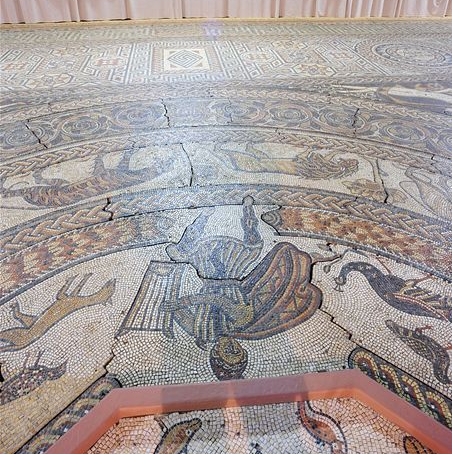
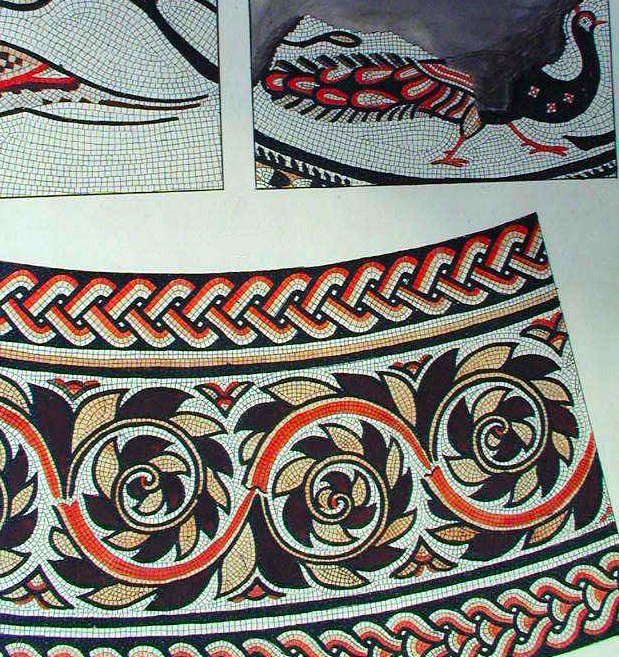
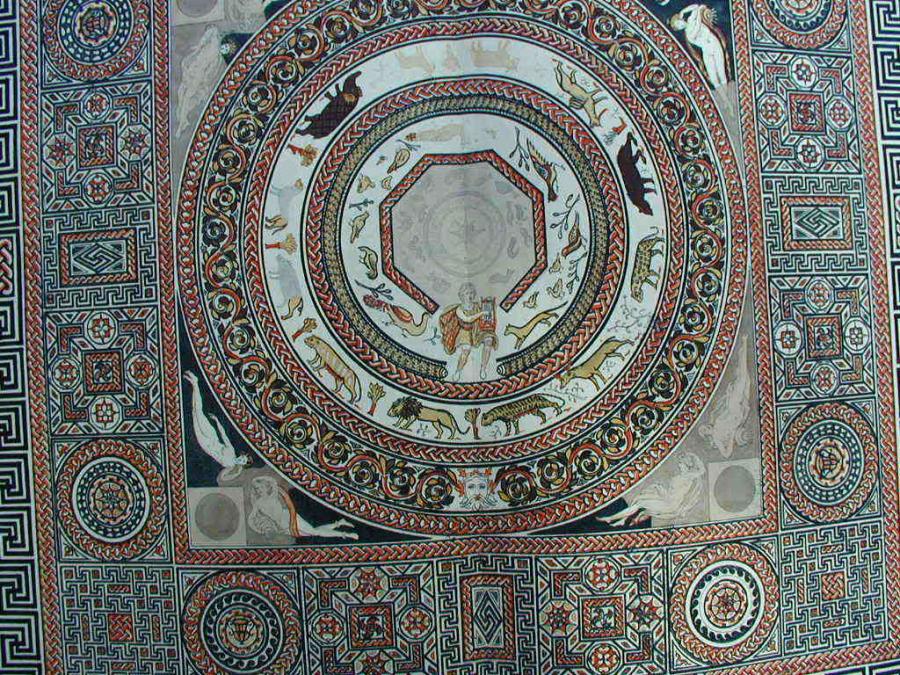
Simon Chorley Auctions has sold the 'Orpheus Pavement', estimated to be worth £1m when its was valued in 1997, for £75,000 plus commission. The pavement was a replica of the Roman mosaic found at Woodchester and made by Bob and John Woodward between 1973-1983.
The original mosaic was made c350 by workers from Corinium, which is present-day Cirencester and was the largest Roman town in Britain outside London. This Roman mosaic is the largest known in northern Europe was put on show in 1973 which resulted in 140,000 visitors and traffic issues, after which it was covered over again.
The replica mosaic was owned by Alec Lawless of Aqua Oleum essential oils. The BBC reported him as saying that he wanted the mosaic to stay in the Woodchester area, ideally alongside an established tourist attraction.
The following is an extract about the original mosaic from Faustus at the 'Ancient Romand Empire Forums':
The Orpheus pavements of Cirencester and Woodchester are a Romano-British Specialty and belong to a moment when the tale had become a vehicle of both pagan and Christian teaching. Dionysiac legend also had its place, as at East Coker, Somerset, where the story of the divine birth may be recognized. The Labours of Hercules appear at Bramdean, Hampshire, the story of Cyparissus at Leicester. These echo not Virgil, but the hardly less beloved Ovid.
Woodchester villa's plan is of the courtyard type confirming to typical Italian design. There are comparatively few of this layout in England. It had two large courtyards surrounded by buildings with 65 rooms including a main residence, a farm, a sun terrace, a spa and bath complex, and a large hall that contained the wonderful Orpheus mosaic. This is one of the most complex and intricate mosaic designs found in northern Europe, and is 2,209 square feet and when complete contained one and a half million pieces of stone. This great mosaic was made around AD 325 by craftsmen from Corinium, with the main design based around Orpheus and his relationship with nature.
Genre scenes are less common, and this in itself suggests a fairly rigid adherence to the pattern-book rather than the commissioned composition. But the hunting-scenes from Pitney, unfortunately only fragmentary, or the combined chariot and horse race at Horkstow, the bigae et equi desultorii of Roman aristocratic sports, must represent the special commission, as plainly related to the particular tastes of the client as the Gnostic pavement at Brading.
A half-way stage between the purely conventional pattern and the figured pavement is represented by the marine compositions of sea-creatures, fish, and shell-fish, or by the heads of Neptune, commonly though not exclusively associated with baths. These also are based upon Mediterranean models, but the idea is one so easily borrowed that it would be unfair to dub them representative of Mediterranean taste. They stand rather for a specialized pattern applied to a particular type of activity, namely, bathing. The purely conventional pattern, on the other hand, is linked with no special room or purpose, and its ubiquity proclaims it as the prime favourite of Romano-British taste, with both patron and worker. There is no doubt that, as Sir Thomas Kendrick has observed it ministered to the native British predilection both for abstract pattern and for that equality of emphasis upon pattern and background which gave them an almost magical interchangeability. There were, too, certain shapes, and notably the pelta, which had long been part of the repertory of Celtic art: and these were not employed, always with an eye to background, in new patterns of classical rigidity wherein colour played a major part. This was a new movement in British art, matched by the contemporary advances in enamel-work.
As the vehicle of unity of design, colour now took the place of flow, and the desired effect, rarely unachieved, was of a glowing kaleidoscopic pattern controlled by the rigidity of form but softened by the fact that, while major patterns produced the overall effect, the eye might dwell with equal satisfaction on minor designs within the major units. Further the colour scheme was seldom harsh or clashing: in contrast with the hot contrasts of Mediterranean marbles it reflects the cool days and soft colours of the British climate. The colours glow, but in rich restraint, as in a page of the Lindisfarne gospels.
Update:
Roman replica will not return despite villagers' £150,000 bid: 'The agent told the bidders that “the owner is not interested in your offer or your expert valuations.'
Roman replica will not return despite villagers' £150,000 bid
Story Type: Auction Report