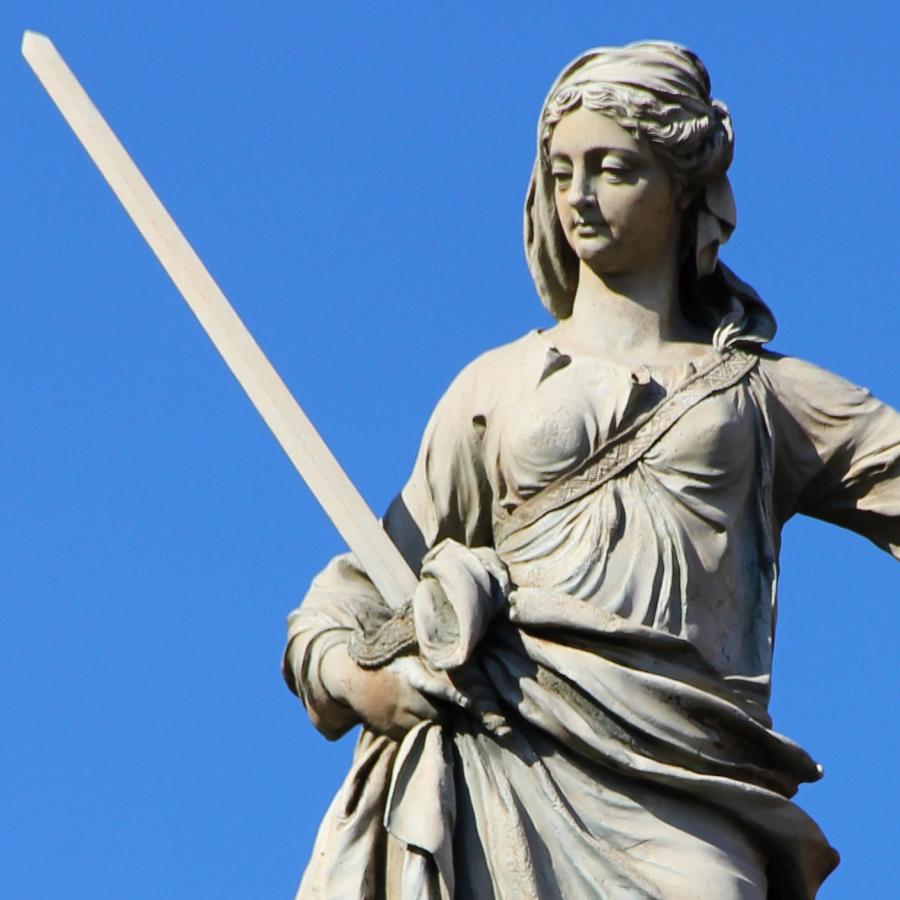
John van Nost the younger (1713-1780) was born in London, son of John Nost II who was apprenticed to his cousin, the Flemish John van Nost the Elder, a Huguenot refugee lead worker and sculptor who fled Mechelin in the 1680s. Between the elder and the younger, John Nost II, ran the Nost lead business near Hyde Park corner to 1710 to 1729.
The mass movement of persecuted protestant refugees in two waves in the 1500s and the later 1600s, mostly artists and craftspeople, dispersed French and Low Countries craft skills to Britain and Ireland which, among other flourishing artisan workshops, resulted in van Nost and others establishing a successful lead statuary trade around London.
The prodigious output resulted in classical figures and garden ornament being planted in the landscaped gardens of every English mansion from Northumberland to Devon, and finials and statues on the rooftops of most Georgian cities.
John Van Nost the Younger worked in the family business after an apprenticeship with Henry Scheemakers and then moved to Dublin where in 1749 he modelled a terracotta bust for the Dublin Society and, due to the considerable demand for sculpture there, soon established an extensive practice in busts, monuments and royal statues.
Irish Fine Art in the Early Modern Period: New Perspectives on Artistic Practice, 1620-1820 is a collection of essays which includes 50 pages on John van Nost's Irish output entitled
The "Strange and Unaccountable" John Van Nost: The Making of a Sculptural Career in Eighteenth-Century Ireland by M.G. Sullivan.
This richly illustrated book presents the latest research into Irish fine art from the 17th and 18th centuries. It is comprised of a rich selection of case studies into artistic practice that showcase the burgeoning nature of fine art media in Ireland, the quality of production, and the breadth of patronage. In his review
Irishness is not the most interesting thing about Irish art in Apollo magazine, Robert O'Byrne wrote:
As Sullivan remarks, his [John Nost the Younger's] subsequent career in Ireland begs the question how he was able 'despite apparently arriving with little reputation, no wealthy patron and no particular commission, to create a sculptor's career in Ireland in the 1750s and 1760s'.
It was not just any career but one which, with occasional setbacks, flourished - even if van Nost's attested output remains relatively small. He benefitted from timing, arriving in Ireland just as an awareness of the need for an indigenous school of sculpture emerged, so that almost immediately patronage and commissions flowed from the Dublin Society. Established in 1731 'for improving Husbandry, Manufactures and other Useful Arts', the society was linked with many of the country's most affluent and influential citizens, and through his own early ties van Nost was in a position to receive offers from them for further work.
The importance of such support is well understood but further research remains to be undertaken on the broader relationship between artists in Ireland and their clientele during this period. If the former were accustomed to travel to Britain and beyond, so too were their patrons who, having seen what was being produced elsewhere, expected similar standards of excellence at home. The second half of the 18th century witnessed a residential building boom in both urban and rural Ireland: these houses had to be furnished with fine art and much of it came from abroad. If indigenous artists were to prosper, they needed to be as good as, if not better than, what was being imported. Hence Sullivan quotes the entrepreneur and theatre manager Benjamin Victor writing of van Nost in 1756 that he was 'a greater master than Risbriac [sic], or Scheemaker [sic]; I will only except Roubiliac.'
Irish Fine Art in the Early Modern Period: New Perspectives on Artistic Practice, 1620-1820 by Jane Fenlon, Ruth Kenny, Caroline Pegum, Brendan Rooney (eds.), is published by Irish Academic Press.