Zhejiang, China
Wang Shu only started the Amateur Architecture Studio in Hangzhou in 1997. In 2012 he won the Pritzker architecture prize and was in Time magazine's list of the world's 100 most influential people in 2013.
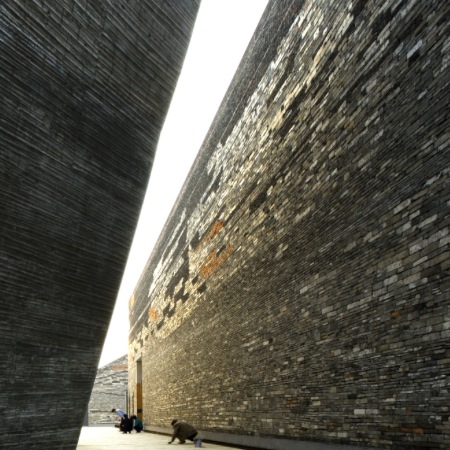
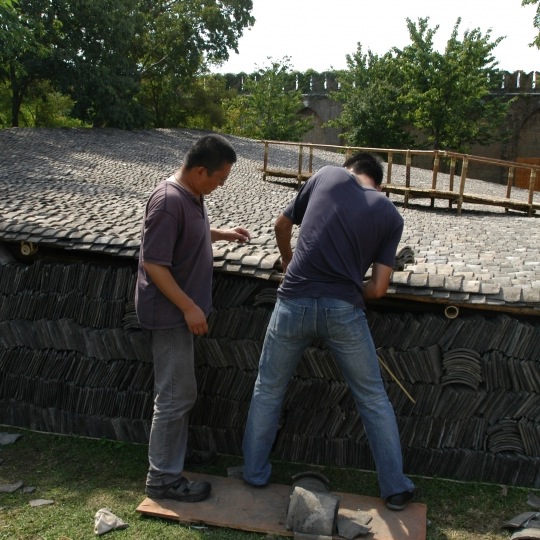
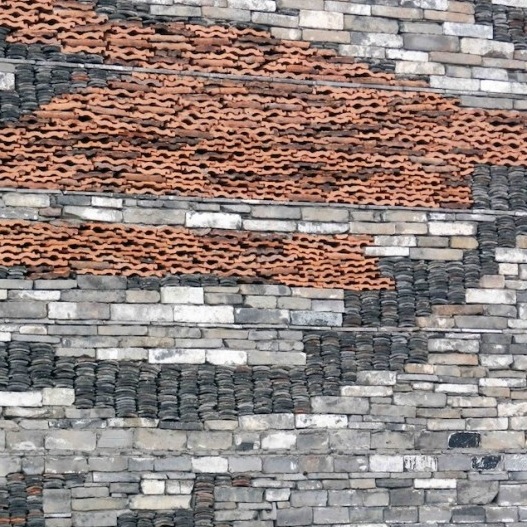
He is most famous for reusing reclaimed building material, not just on small buildings and houses but for industrial size buildings such as the 60,000 square metre history museum in Ningbo which took five years, and where he reused 7 million bricks collected from the demolition of buildings on the same site. He is a teaching professor of architecture, and he spends time on the tools with craftspeople. His early work was mainly renovating old buildings. Latterly he has become an international architecture celebrity - today he was presiding over a forum in Singapore about innovative cities in Asia. At the Venice biennale he built an installation reusing 66,000 old roof tiles, called 'Tiles Garden', which was a training exercise for the roof of a building he planned to build later in China. He spends much time experimenting with reuse construction methods.
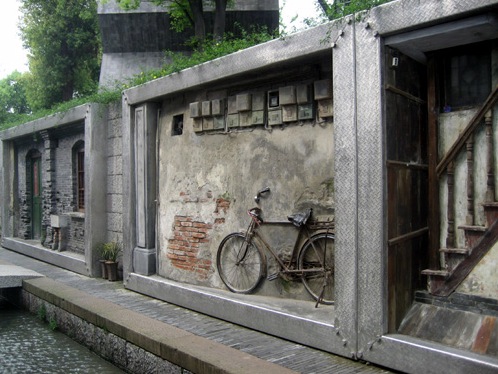
From 1990 to 1998, he had no commissions, and he preferred not to take a government or academic position. Instead, he went to work with craftsmen to gain experience in actual building. Every day, from eight in the morning until midnight, he worked and ate with the craftsmen, considered by many to be the lowest level of their society, but he learned everything he could about construction practices. The projects he did at that time were all renovation projects of old buildings, and because old buildings were deconstructed during the fast development of cities, these small works of his were also demolished.
"There are no known standards for building with reclaimed building materials," he said at a lecture in USA, "so we experiment. I learn from old building methods, and I allow the craftspeople who work for me to use their skills and imagination. This creates unexpected beauty."
Wang Shu is a self-taught artist born in Urumqi near the old Silk Route in the far west of China. He started the Amateur Architecture Studio with his wife and collaborator, Lu Wenyu, together with a movable group of up to four interns. He does not believe in large practices.
He explains his design process as very similar to the traditional Chinese painter. First, he studies the cities, the valleys and the mountains. Then he thinks about these things for about a week, not drawing at all. Then, as was the case with the Ningbo Historic Museum, one night when he could not sleep, the design materialized in his mind. He immediately took pencil to paper and drew everything, including numbers, structure, sizes of spaces, locations of entrances, and other functions. "Then," he says, "I drank tea." The whole process is one of thinking, drawing, and discussing. Step by step, a more defined project evolves, and then assistants from his office participate creating further plans and drawings using the computer. A next step involves a discussion about details and materials.
He described another situation when he had to design three museums in different places at the same time, "My wife, Lu Wenyu, and I are the only partners in the studio. The rest are all our students. I sent them all home for a month so I could work on these three museums. But they were not on vacation. They all had homework assignments: books on French philosophy, or Chinese paintings, movies, or whatever might be helpful. When we all got back together," he says, "we had discussions before we began work again." His role of teacher extends beyond his studio. In 2000, he became a professor at the China Academy of Art in Hangzhou. In 2003, he was named head of the Architecture Department there, and in 2007, he was made the Dean of the Architecture School.
By naming his practice 'Amateur Architecture Studio' Wang explains that the implication should be that the handicraft aspect of his work is more important to him that what he considers much of the professionalized, soulless architecture as practiced today.
Wang also speaks of the temporary character of his firm's work. "My belief is that architecture should work hand-in-hand with time. Sometimes I prefer to use less costly materials that can be replaced when damaged. And I associated buildings and plants - when they come together, as long as time keeps going, architecture is subject to constant changes. Temporary as I use the word is not meant to mean disposable."
It is not the case that every Wang Shu project is mainly reclaimed building materials, but it would seem that most of them do reuse some, and many - especially Ningbo History Museum - reuse on a giant scale.
Amateur Architecture Studio
Salvo Directory 09 May 2013
De Zeen: Key projects by Wang Shu
Story Type: News